

A fully laminated medical touchscreen needs a device-specific evaluation, not an assumption that optical joining makes a component suitable for clinical use. Readability, input errors, cleaning and replacement interact at the complete-device level. This guide helps OEM engineering and procurement define the component evidence they need while leaving device safety and regulatory decisions with the responsible manufacturer. Compare the actual cover, sensor, display, controller and enclosure before accepting a sample.
Contents: 1 · 2 · 3 · 4 · 5 · 6 · 7 · 8 · 9 · 10
1. Which clinical workflow sets the interface requirements?
Identify intended operators, operating locations and consequential tasks with the device team. A monitor used for observation differs from a control that changes therapy settings. Also, glove use and viewing distance vary across workflows. Record required actions before discussing a bonding material or front appearance.
A laboratory demonstration may omit the task with the greatest error consequence. Optical clarity cannot resolve an unsafe interaction design.
Buyer checklist for fully laminated medical touchscreen
Start with intended use. Map representative tasks to observable input and viewing requirements. Ask the device risk owner to identify critical interactions and review the proposed component tests against those boundaries.
- Operator group
- Viewing distance
- Critical interaction
- Risk owner
| Decision point | Requirement to retain | Related check |
|---|---|---|
| Failure boundary | A laboratory demonstration may omit the task with the greatest error consequence. Optical clarity cannot resolve an unsafe interaction design. | Critical interaction |
| Approval action | Map representative tasks to observable input and viewing requirements. Ask the device risk owner to identify critical interactions and review the proposed component tests against those boundaries. | Risk owner |
Review the capacitive product context if glass-front or gesture operation enters the specification. capacitive touchscreen options.
2. What optical evidence belongs in a medical sample review?
Evaluate the actual interface content at relevant positions and ambient lighting. Suitable optical coupling can reduce reflection at the addressed gap, but front glare and display characteristics still matter. Meanwhile, labels, traces and alarm indicators can place different demands on contrast. Compare complete assemblies rather than isolated glass.
An attractive test photograph does not establish reliable reading of required information. Different display settings can bias the comparison.

Which evidence should accompany the sample?
Judge the required information. Retain controlled viewing conditions and sample identities. Have representative users perform defined reading tasks, then inspect visible defects and missed information under the same settings used for acceptance.
- Interface content
- Ambient light
- Viewing position
- Settings record
| Decision point | Requirement to retain | Related check |
|---|---|---|
| Failure boundary | An attractive test photograph does not establish reliable reading of required information. Different display settings can bias the comparison. | Viewing position |
| Approval action | Retain controlled viewing conditions and sample identities. Have representative users perform defined reading tasks, then inspect visible defects and missed information under the same settings used for acceptance. | Settings record |
Use the pressure-input product context when a suitable blunt stylus or glove is required. resistive touchscreen options.
3. How should medical glove input be assessed?
Use the glove types and fit identified by the device team. Test taps, release, dragging and small targets on the installed screen. Also, record wet or contaminated states only where the intended workflow requires them. The assembled sensor and controller determine input behavior; a bonded layer alone does not establish glove operation.
A convenient glove substitute can hide retries or false input. Increasing sensitivity may change idle behavior or another operating state.
What should the test owner record?
Keep gloves configuration-specific. Name each approved glove sample and controller revision. Observe required tasks and unintended events, then repeat relevant conditions after tuning or changes to the cover, adhesive or mounting stack.
- Glove identity
- Target location
- Unintended events
- Controller revision
| Decision point | Requirement to retain | Related check |
|---|---|---|
| Failure boundary | A convenient glove substitute can hide retries or false input. Increasing sensitivity may change idle behavior or another operating state. | Unintended events |
| Approval action | Name each approved glove sample and controller revision. Observe required tasks and unintended events, then repeat relevant conditions after tuning or changes to the cover, adhesive or mounting stack. | Controller revision |
A bonding proposal changes the assembled optical and mechanical interface; review its construction context. fully laminated touchscreen construction.
Primary reference: FDA human-factors and usability guidance. Verify its applicable scope against the proposed build.
4. What should the cleaning specification contain?
State the agent, concentration, application method, contact period and cleaning frequency as applicable to the device instructions. Include the bezel and exposed edges. Meanwhile, repeated exposure may affect coatings, printing, seals and adhesive interfaces differently. A flush front simplifies access without proving compatibility with every disinfectant.
A single successful wipe cannot establish repeated-use material compatibility. An unnamed cleaner makes supplier evidence difficult to interpret.
Which installed detail needs approval?
Specify the real cleaning procedure. Ask the device owner for the approved cleaning procedure. Request relevant material evidence and run a defined repeated-exposure evaluation, then inspect appearance, input recovery and edge condition against agreed limits.
- Agent identity
- Application method
- Exposure plan
- Recovery criteria
| Decision point | Requirement to retain | Related check |
|---|---|---|
| Failure boundary | A single successful wipe cannot establish repeated-use material compatibility. An unnamed cleaner makes supplier evidence difficult to interpret. | Exposure plan |
| Approval action | Ask the device owner for the approved cleaning procedure. Request relevant material evidence and run a defined repeated-exposure evaluation, then inspect appearance, input recovery and edge condition against agreed limits. | Recovery criteria |
For a machine installation, relate these checks to mounted-console and operator conditions. industrial control touchscreen context.
5. How does the enclosure change the component result?
Fasteners, gasket compression and rear support can change stress in the optical stack. Also, protective housings influence heat flow and accessible edges. Test the mounted configuration rather than only a loose module. Keep enclosure ingress and electrical safety questions in their own qualification plans instead of attributing them to lamination.
Edge pressure can distort the display or sensing behavior. A module report does not qualify the assembled enclosure.
How can engineering close this check?
Inspect after final mounting. Release a mounting cross-section with support and clearance references. Inspect optics and input after assembly, then assign device-level protection and electrical evaluations to the appropriate qualified owners.
- Gasket compression
- Rear clearance
- Support locations
- Device-level tests
| Decision point | Requirement to retain | Related check |
|---|---|---|
| Failure boundary | Edge pressure can distort the display or sensing behavior. A module report does not qualify the assembled enclosure. | Support locations |
| Approval action | Release a mounting cross-section with support and clearance references. Inspect optics and input after assembly, then assign device-level protection and electrical evaluations to the appropriate qualified owners. | Device-level tests |
Healthcare equipment introduces device-specific cleaning and qualification questions; keep those outside generic component claims. medical touchscreen context.
6. Which operating states can expose input problems?
Include startup, normal operation, charging or supply transitions and other relevant equipment states. Display activity and attached electronics may change the sensing environment. Meanwhile, host software can reject or duplicate otherwise valid events. Separate touch reports from application behavior so the team investigates the correct layer.
A quiet bench test can miss a condition present during actual use. Visible delay does not by itself identify an adhesive defect.
What failure would reject this configuration?
Trace the complete input path. Create a state-and-task matrix with electronics and software owners. Retain touch-event and host logs where useful, then reproduce failures on the accepted hardware and firmware configuration before modifying materials.
- Equipment state
- Touch events
- Host response
- Configuration identity
| Decision point | Requirement to retain | Related check |
|---|---|---|
| Failure boundary | A quiet bench test can miss a condition present during actual use. Visible delay does not by itself identify an adhesive defect. | Host response |
| Approval action | Create a state-and-task matrix with electronics and software owners. Retain touch-event and host logs where useful, then reproduce failures on the accepted hardware and firmware configuration before modifying materials. | Configuration identity |
Compare the application boundary before assuming a single demonstration covers every installation. application solution overview.
7. What does component evidence establish about compliance?
Supplier reports should state their sample, method, conditions and scope. They can support a device evaluation without replacing it. Also, human-factors work concerns the complete user interface and intended use. Do not convert a material datasheet or cleanroom photograph into a claim that the finished medical device is approved.
Broad certification language can conceal missing device-level evidence. An unrelated sample report may not apply to the proposed stack.
What should quality retain?
Keep claims within their scope. Request the exact report scope and configuration references. Let the responsible device team determine applicable obligations and remaining work, then document exclusions explicitly in the component acceptance pack.
- Report identity
- Sample revision
- Method scope
- Remaining obligations
| Decision point | Requirement to retain | Related check |
|---|---|---|
| Failure boundary | Broad certification language can conceal missing device-level evidence. An unrelated sample report may not apply to the proposed stack. | Method scope |
| Approval action | Request the exact report scope and configuration references. Let the responsible device team determine applicable obligations and remaining work, then document exclusions explicitly in the component acceptance pack. | Remaining obligations |
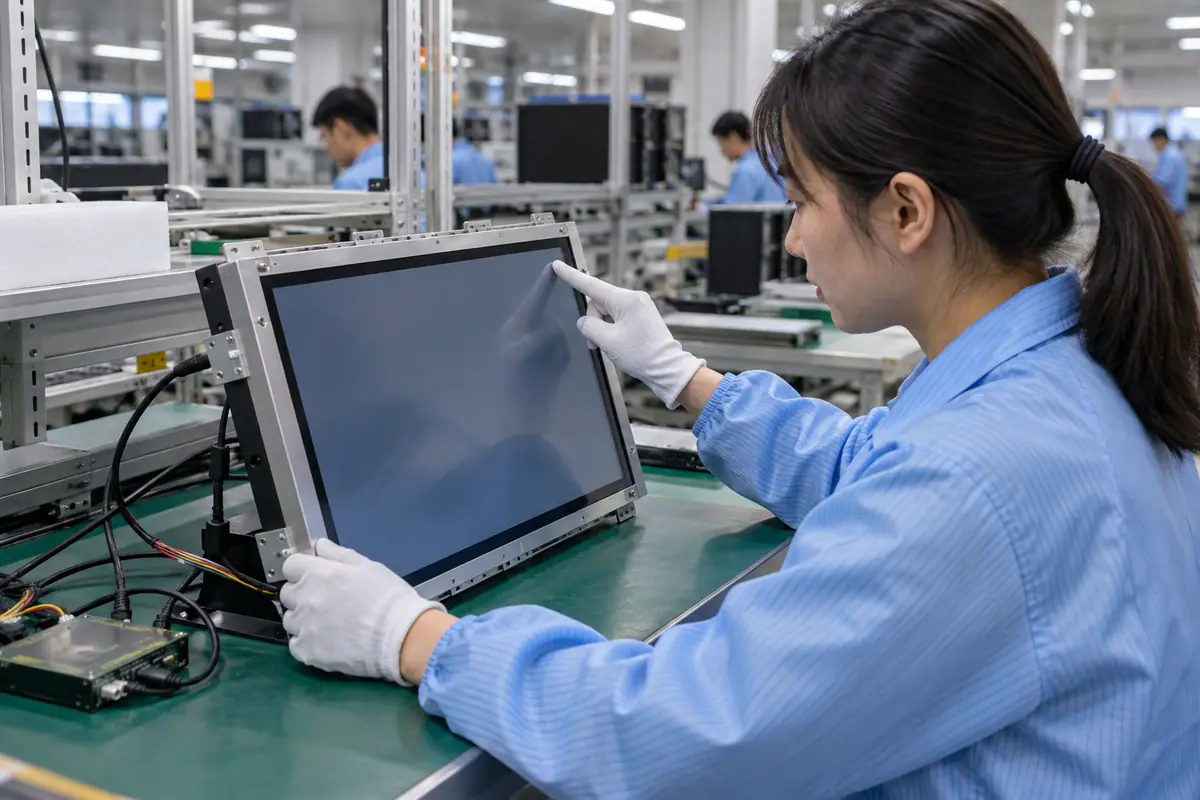
Review public supplier information alongside evidence for the actual part being quoted. factory background.
8. What replacement boundary protects the approved configuration?
Decide whether service replaces the complete module or another qualified assembly. Bond separation may require specialist equipment and new inspection. Meanwhile, a spare with a different controller can change interaction behavior. The service route should preserve the device configuration and provide a defined post-repair verification, not merely a fitting connector.
Uncontrolled repairs can change optics, touch response or cleaning interfaces. Physical interchangeability does not prove equivalent device behavior.

Which trial result changes the decision?
Qualify the service route. Define approved spare references and authorized repair responsibilities. Demonstrate access and recovery checks, then connect service records to the module and software revisions used during device evaluation.
- Spare identity
- Repair authority
- Software match
- Post-repair verification
| Decision point | Requirement to retain | Related check |
|---|---|---|
| Failure boundary | Uncontrolled repairs can change optics, touch response or cleaning interfaces. Physical interchangeability does not prove equivalent device behavior. | Software match |
| Approval action | Define approved spare references and authorized repair responsibilities. Demonstrate access and recovery checks, then connect service records to the module and software revisions used during device evaluation. | Post-repair verification |
Send the controlled drawing and unresolved test questions with the sample configuration attached. technical inquiry route.
For example, a diagnostic-equipment team might find that a joined sample improves trace visibility but produces extra input during a powered cleaning wipe. Keep the optical result and the cleaning interaction as separate findings. Review the device workflow, approved cleaning state and configuration before accepting the module. This hypothetical example illustrates a component review; it is not clinical validation or a claim about any supplied product.
9. How should the supplier and OEM divide acceptance work?
The factory may inspect bond appearance, dimensions and communication while the OEM evaluates intended-use tasks. Make that division visible. Also, customer-supplied LCDs need incoming condition and loss ownership rules. A clear responsibility matrix helps purchasing compare quotes without assuming every supplier includes device-level trials.
An unowned test can be omitted by both parties. A low quote may exclude inspection or evidence needed for the device program.
How can purchasing compare the evidence?
Allocate every acceptance decision. Attach the acceptance matrix and sample references to the RFQ. Close pilot findings with named owners, then retain the agreed inspection, traceability and device-level exclusions before repeat orders.
- Factory checks
- OEM trials
- Customer parts
- Pilot closure
| Decision point | Requirement to retain | Related check |
|---|---|---|
| Failure boundary | An unowned test can be omitted by both parties. A low quote may exclude inspection or evidence needed for the device program. | Customer parts |
| Approval action | Attach the acceptance matrix and sample references to the RFQ. Close pilot findings with named owners, then retain the agreed inspection, traceability and device-level exclusions before repeat orders. | Pilot closure |
Module quotes need a defined LCD, sensor and controller boundary. touch display module scope.
10. What should be frozen before repeat production?
Release the accepted front stack, controller, mounting and intended-use constraints together. Include cleaning and service references. By contrast, fully laminated medical touchscreen is only a category description. Material substitutions or firmware updates may affect previously evaluated behavior and should trigger a proportionate review by the responsible device team.
A generic purchase description can permit an unreviewed variant. Customer-side changes can invalidate evidence even when the bond material is unchanged.
What should the team release next?
Release evidence-linked supply. Order against controlled references and require relevant change notices. Route proposed substitutions through the device change process, then repeat affected component and interface checks before accepting the revised configuration.
- Stack reference
- Cleaning procedure
- Service boundary
- Change review
Frequently asked questions about fully laminated medical touchscreen
Q1: Does optical joining make a screen medically approved? No. The responsible device manufacturer must determine applicable requirements and complete device-level evaluation.
Q2: Can the factory validate every disinfectant? Only specific materials and defined exposure conditions can be meaningfully evaluated; request applicable evidence.
Q3: Which glove should be used for the pilot? Use the types and fit identified in the intended workflow, with controlled sample identities.
Q4: Should a loose module pass be enough? No. Mounting, host behavior and intended-use tasks still require relevant installed evaluation.
Q5: What should accompany a replacement module? Approved hardware and software references, service instructions and device-appropriate recovery checks.