
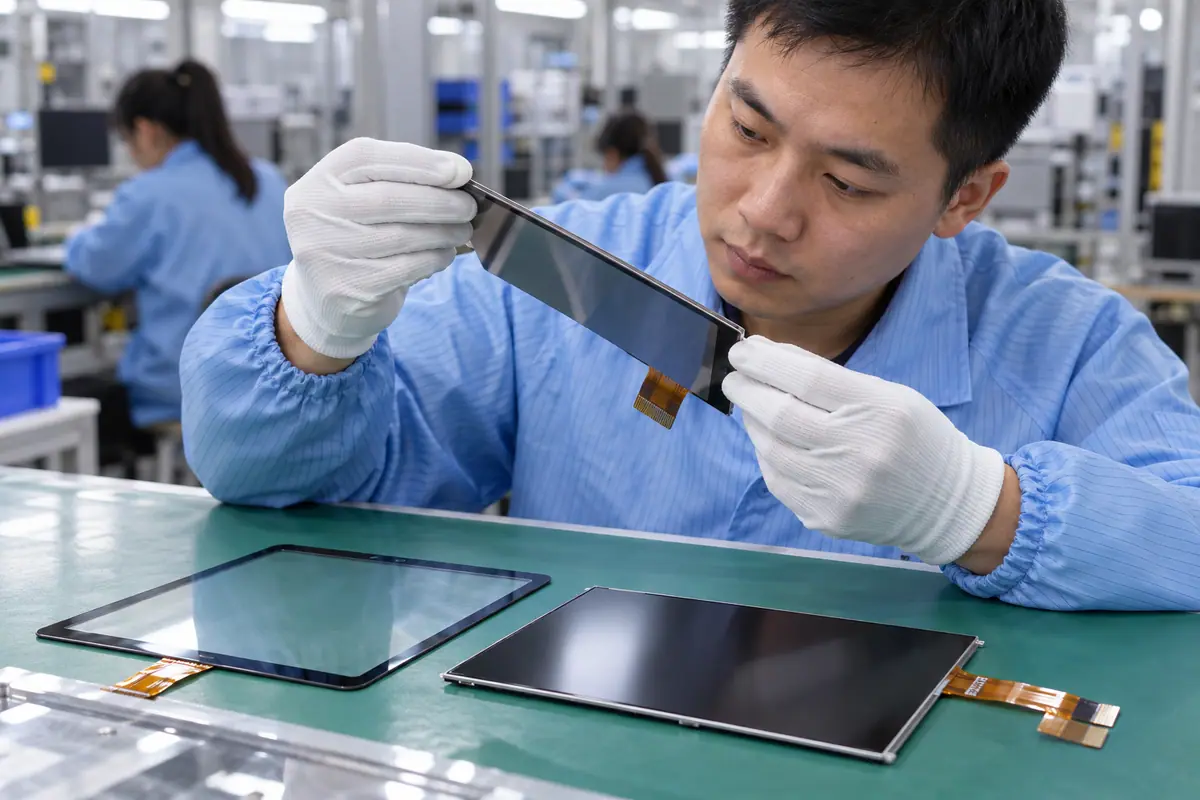
A fully laminated touchscreen joins specified optical layers across their viewing area rather than leaving an intentional air space at that interface. The term does not identify every supplied layer or controller. A buyer asking what is a fully laminated touchscreen should request a cross-section and a finished-module test. This guide explains the delivered product boundary, remaining reflections, touch integration and repair implications. It does not treat lamination as automatic proof of waterproofing, impact resistance or device certification.
Contents: 1 · 2 · 3 · 4 · 5 · 6 · 7 · 8 · 9 · 10
1. What does fully laminated describe?
The phrase describes a joined optical interface, but suppliers may apply it to different stacks. For example, cover-to-sensor joining and sensor-to-LCD joining are separate boundaries. Meanwhile, a complete module may include boards or only passive optical parts. Identify each joined surface before comparing products.
A familiar product name can hide an unbonded interface or excluded electronics. Outside appearance cannot establish the complete cross-section.
Buyer checklist for what is a fully laminated touchscreen
Name every joined interface. Request a layer drawing with every joined and spaced interface marked. Match that drawing with the quote and representative sample before accepting the fully laminated description.
- Cover boundary
- Sensor boundary
- LCD boundary
- Delivered boards
| Decision point | Requirement to retain | Related check |
|---|---|---|
| Failure boundary | A familiar product name can hide an unbonded interface or excluded electronics. Outside appearance cannot establish the complete cross-section. | LCD boundary |
| Approval action | Request a layer drawing with every joined and spaced interface marked. Match that drawing with the quote and representative sample before accepting the fully laminated description. | Delivered boards |
For a machine installation, relate these checks to mounted-console and operator conditions. industrial control touchscreen context.
2. Which layers must the buyer identify?
Record cover, sensor, adhesive, LCD and any support frame separately. Also, distinguish permanent assembly parts from temporary protective liners. The display reference determines visible area and host requirements. A clear front surface cannot tell purchasing which components or configuration will arrive with production orders.
An unidentified LCD or cover substitution can change optics, thickness or sensing behavior. A sample tray can include evaluation-only parts.

Which evidence should accompany the sample?
Inventory the finished stack. Reconcile a controlled bill of materials with the physical sample. Mark customer-supplied parts and excluded controllers, then keep approved references attached to the module drawing.
- Cover reference
- Sensor identity
- LCD reference
- Assembly scope
| Decision point | Requirement to retain | Related check |
|---|---|---|
| Failure boundary | An unidentified LCD or cover substitution can change optics, thickness or sensing behavior. A sample tray can include evaluation-only parts. | LCD reference |
| Approval action | Reconcile a controlled bill of materials with the physical sample. Mark customer-supplied parts and excluded controllers, then keep approved references attached to the module drawing. | Assembly scope |
Healthcare equipment introduces device-specific cleaning and qualification questions; keep those outside generic component claims. medical touchscreen context.
3. Why can the joined stack look clearer?
Replacing a specified air interface with suitable optical material can reduce reflections at that interface. However, front-surface glare and other interfaces remain. Inspect relevant content under common lighting. A favorable comparison photograph does not establish a fixed improvement for every cover, adhesive and LCD combination.
Comparing different brightness settings or displays can exaggerate a bonding benefit. Clear adhesive alone cannot guarantee outdoor readability.
What should the test owner record?
Compare equal optical conditions. Compare production-intent stacks with equivalent content, brightness and observation positions. Record remaining glare and defects rather than promising an unsourced transmission or contrast percentage.
- Common content
- Brightness setting
- Observation angle
- Remaining reflections
| Decision point | Requirement to retain | Related check |
|---|---|---|
| Failure boundary | Comparing different brightness settings or displays can exaggerate a bonding benefit. Clear adhesive alone cannot guarantee outdoor readability. | Observation angle |
| Approval action | Compare production-intent stacks with equivalent content, brightness and observation positions. Record remaining glare and defects rather than promising an unsourced transmission or contrast percentage. | Remaining reflections |
Compare the application boundary before assuming a single demonstration covers every installation. application solution overview.
Primary reference: 3M optically clear adhesive application context. Verify its applicable scope against the proposed build.
4. What does lamination change mechanically?
Joining layers changes how they share loads and thermal movement. For example, a rigid cover can transfer stress into an LCD through the selected adhesive and support. Also, the assembled frame still determines mounting loads. A strong-looking front is not a complete mechanical qualification.
Poor support can produce display distortion or edge damage after mounting. Adhesive selection cannot compensate for every enclosure interference.
Which installed detail needs approval?
Keep support in the qualification. Review the fitted cross-section and support arrangement with mechanical owners. Inspect optical and touch behavior after fastening, then validate relevant operating conditions on that installed configuration.
- Cover stiffness
- Adhesive behavior
- LCD support
- Mounting load
| Decision point | Requirement to retain | Related check |
|---|---|---|
| Failure boundary | Poor support can produce display distortion or edge damage after mounting. Adhesive selection cannot compensate for every enclosure interference. | LCD support |
| Approval action | Review the fitted cross-section and support arrangement with mechanical owners. Inspect optical and touch behavior after fastening, then validate relevant operating conditions on that installed configuration. | Mounting load |
Review public supplier information alongside evidence for the actual part being quoted. factory background.
5. How should touch be tested after joining?
Use the actual controller, cover and powered LCD during acceptance. PCAP behavior can change with its assembled electrical and dielectric environment. Meanwhile, a pressure-based construction needs an appropriate architecture and freedom for intended movement. Do not transfer a bonding recipe blindly between sensor mechanisms.
A loose-sensor pass may not reproduce fitted edge response. Undocumented tuning changes can alter approved glove or moisture behavior.

How can engineering close this check?
Validate the joined input path. Run named input tasks after the production joining process. Retain controller and host settings, then repeat center, edge, release and idle checks following relevant stack changes.
- Sensor architecture
- Controller settings
- Powered LCD
- Required inputs
| Decision point | Requirement to retain | Related check |
|---|---|---|
| Failure boundary | A loose-sensor pass may not reproduce fitted edge response. Undocumented tuning changes can alter approved glove or moisture behavior. | Powered LCD |
| Approval action | Run named input tasks after the production joining process. Retain controller and host settings, then repeat center, edge, release and idle checks following relevant stack changes. | Required inputs |
Send the controlled drawing and unresolved test questions with the sample configuration attached. technical inquiry route.
6. Does full lamination establish environmental protection?
A joined optical area does not define housing seams, cable entries or rear connectors. Also, material durability and usable wet input are separate questions. Ask which exposure states the complete product must handle. Component evidence should retain its sample boundary instead of becoming a general enclosure claim.
A successful damp-finger trial does not prove sealing. A sealed housing can still have unsuitable cleaning or touch behavior.
What failure would reject this configuration?
Separate three protection questions. Separate sealing, material compatibility and input acceptance in the test plan. Require evidence for the intended assembled product before quoting any environmental protection rating or operating claim.
- Housing seal
- Material exposure
- Wet input
- Report scope
| Decision point | Requirement to retain | Related check |
|---|---|---|
| Failure boundary | A successful damp-finger trial does not prove sealing. A sealed housing can still have unsuitable cleaning or touch behavior. | Wet input |
| Approval action | Separate sealing, material compatibility and input acceptance in the test plan. Require evidence for the intended assembled product before quoting any environmental protection rating or operating claim. | Report scope |
Module quotes need a defined LCD, sensor and controller boundary. touch display module scope.
7. How should visual defects be specified?
Agree on visible zones, illumination and observation distance before inspecting bonded samples. Bubbles, particles, alignment and uneven appearance need distinct criteria. Meanwhile, a defect near an inactive border may have a different acceptance consequence from one over required text. Keep the method reproducible.
A vague perfect-glass requirement can create receiving disputes. One photograph may hide defects visible under another condition.
What should quality retain?
Make the inspection method shared. Define inspection conditions and defect categories with quality staff. Retain reference samples and findings, then apply the same method to factory and receiving checks.
- Visible zone
- Lighting method
- Alignment limit
- Reference sample
| Decision point | Requirement to retain | Related check |
|---|---|---|
| Failure boundary | A vague perfect-glass requirement can create receiving disputes. One photograph may hide defects visible under another condition. | Alignment limit |
| Approval action | Define inspection conditions and defect categories with quality staff. Retain reference samples and findings, then apply the same method to factory and receiving checks. | Reference sample |
Review the capacitive product context if glass-front or gesture operation enters the specification. capacitive touchscreen options.
8. What does repair require?
A joined stack can need specialized separation or whole-module replacement. Actual options depend on adhesive, layers and enclosure access. Also, apparently successful rework may damage a polarizer, sensor or coating. Compare an approved service procedure rather than assuming every bonded layer can be recovered economically.
Unplanned rework can turn one failed layer into a larger scrap assembly. A replacement may need renewed mapping or tuning verification.

Which trial result changes the decision?
Establish the replaceable unit. Request the approved repair boundary and spare configuration. Demonstrate access on a fitted sample, then define post-replacement optical, communication and input checks with the service owner.
- Separation policy
- Spare scope
- Service access
- Post-repair test
| Decision point | Requirement to retain | Related check |
|---|---|---|
| Failure boundary | Unplanned rework can turn one failed layer into a larger scrap assembly. A replacement may need renewed mapping or tuning verification. | Service access |
| Approval action | Request the approved repair boundary and spare configuration. Demonstrate access on a fitted sample, then define post-replacement optical, communication and input checks with the service owner. | Post-repair test |
Use the pressure-input product context when a suitable blunt stylus or glove is required. resistive touchscreen options.
For example, an OEM may receive a module described as fully laminated while its quote includes cover-to-sensor joining only. Ask for a section drawing before comparing it with a complete touch-to-LCD assembly. Then test the actual LCD, controller and frame together. If repair needs a larger spare, include that consequence in procurement. This hypothetical review illustrates a delivery-boundary problem, not a verified result from a customer project.
9. What should a comparable quote contain?
Compare LCD, touch, cover, joining, electronics and acceptance duties on equal scope. Meanwhile, tooling and development should remain separate from recurring module price. A bonded-module bid can include work absent from a loose-parts offer. Ask who handles rejects and investigates interface faults before choosing a low line item.
Unequal scope can move integration and scrap cost into the OEM budget. A bundled price can hide unsupported host work.
How can purchasing compare the evidence?
Normalize the delivered module. Issue one included-parts and test matrix for all suppliers. Require dated offers and explicit exclusions, then compare lifecycle assumptions alongside the tested technical build.
- Included hardware
- Joining work
- Test ownership
- Service exclusions
| Decision point | Requirement to retain | Related check |
|---|---|---|
| Failure boundary | Unequal scope can move integration and scrap cost into the OEM budget. A bundled price can hide unsupported host work. | Test ownership |
| Approval action | Issue one included-parts and test matrix for all suppliers. Require dated offers and explicit exclusions, then compare lifecycle assumptions alongside the tested technical build. | Service exclusions |
A bonding proposal changes the assembled optical and mechanical interface; review its construction context. fully laminated touchscreen construction.
10. What should define a released laminated touchscreen?
Release the exact stack and its installed configuration. Keep materials, controllers, support and relevant test conditions together. By contrast, a product-family name cannot reproduce accepted behavior. Approved alternatives need a difference review. Purchasing should retain a change-notice route covering the interfaces that actually passed acceptance.
A visually similar substitute can change touch or optical behavior. A golden sample without controlled references leaves repeat supply ambiguous.
What should the team release next?
Release the tested combination. Send the reconciled drawing, component list and acceptance record with the order. Require affected-interface review before accepting changed LCDs, adhesives, covers, controllers or mounting arrangements.
- Stack identity
- Installed settings
- Acceptance record
- Change notice
Frequently asked questions about what is a fully laminated touchscreen
Q1: Does fully laminated name a fixed stack? No. Identify every supplied layer, joined interface and excluded electronic function.
Q2: Does it remove all glare? No. Front reflections, surface finish, illumination and the LCD still affect readability.
Q3: Is the module waterproof automatically? No. Seals, cables, housing and intended input states need separate applicable validation.
Q4: Can a bonded LCD be repaired? Some combinations support approved rework; others need a wider replacement assembly. Confirm the actual service route.
Q5: What protects repeat orders? Controlled component and configuration references with shared inspection methods and change-notice rules.