
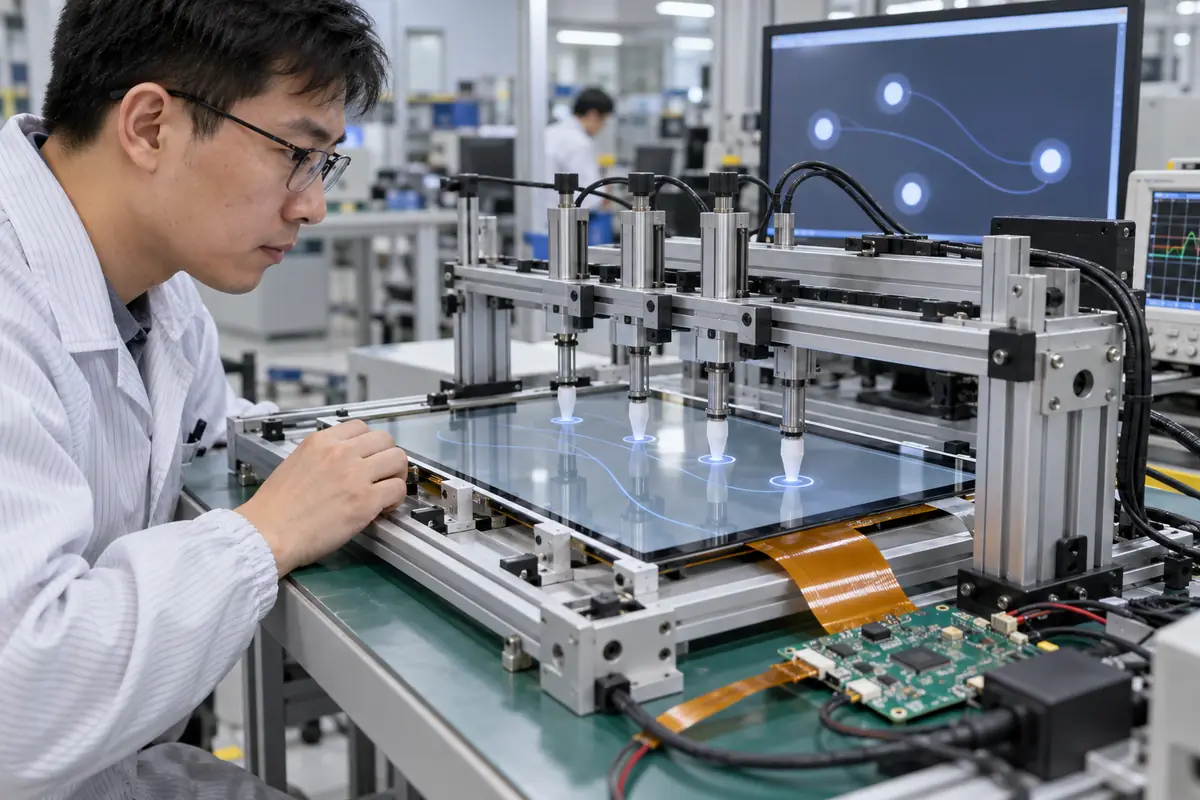
A touchscreen detects a physical interaction, converts it into electrical data, calculates coordinates, and sends an input event to a host. A buyer researching "how does a touchscreen work" may receive mismatched quotations because suppliers use familiar terms for different delivery scopes. This guide applies "how does a touchscreen work" across ten practical checks for engineering, purchasing, and quality teams. For "how does a touchscreen work," Yinghong works from drawings, application conditions, and interface requirements. Use this "how does a touchscreen work" review during RFQ checks, sample approval, integration testing, and production release. That sequence helps your team compare factories on one basis for "how does a touchscreen work" without broad marketing claims. It keeps "how does a touchscreen work" scope connected with evidence that engineers and inspectors can verify.
1. What Happens When a User Touches the Surface?
Touchscreen detection begins when a finger, glove, or stylus changes a measurable property near the sensor. Teams researching "how does a touchscreen work" also need a clear decision on initial touch event. A supplier may demonstrate one input object although production use needs another. Capacitive designs measure field changes while resistive designs measure contact across conductive layers.
Start with initial touch event. Buyers should ask how factory controls carry initial touch event from design review into production. One sample for initial touch event shows a single build at one moment. Batch records for "how does a touchscreen work" reveal whether materials, firmware, tooling, and inspection stayed aligned.
How can buyers test initial touch event?
- List finger use
- Describe glove type
- Name stylus material
- Set touch force needs
| Buyer check | Evidence | Release rule |
|---|---|---|
| List finger use | Controlled drawing | Scope and revision match |
| Describe glove type | Approved sample | Construction matches approval |
| Name stylus material | Relevant test record | Method fits stated use |
| Set touch force needs | Batch inspection record | Result meets agreed limit |
Use the capacitive touchscreen options as related context for "how does a touchscreen work." Buyer action: define every intended input object and test it on a final stack.
2. How Does a Sensor Create Raw Data?
Touchscreen detection relies on repeated electrical measurements across electrodes or resistive axes. In an RFQ, the phrase "how does a touchscreen work" must cover sensor acquisition without ambiguity. Controller hardware scans channels, compares signals with baselines, and captures changes caused by user contact. Poor grounding or high parasitic loading can bury useful change beneath noise.
A drawing for sensor acquisition settles this quickly. A practical decision on sensor acquisition needs application data, product drawings, and relevant evidence. No sales phrase can prove sensor acquisition for "how does a touchscreen work." Keep measurable sensor acquisition acceptance points and approved references available for supplier and buyer.
How can buyers test sensor acquisition?
- Check electrode layout
- Review scan channels
- Measure baseline
- Inspect grounding
| Buyer check | Evidence | Release rule |
|---|---|---|
| Check electrode layout | Controlled drawing | Scope and revision match |
| Review scan channels | Approved sample | Construction matches approval |
| Measure baseline | Relevant test record | Method fits stated use |
| Inspect grounding | Batch inspection record | Result meets agreed limit |
Use the resistive touchscreen options as related context for "how does a touchscreen work." Buyer action: review sensor layout, scan method, grounding, and cable arrangement together.
3. How Does a Controller Find Coordinates?
Touchscreen detection converts channel changes into an X-Y position through controller algorithms and calibration. The question "how does a touchscreen work" also raises a practical issue around coordinate calculation. Bad calibration can create offset, edge loss, jitter, or false movement. Filtering removes noise before centroid or axis calculations estimate where a user touched.
Factory evidence for coordinate calculation beats a sales label. Review coordinate calculation with teams that own mechanics, electronics, firmware, purchasing, and quality. Each function sees a different coordinate calculation failure path. A short cross-functional review prevents expensive assumptions around "how does a touchscreen work" and records ownership.
How can buyers test coordinate calculation?
- Check corner accuracy
- Trace straight lines
- Measure jitter
- Verify edge response
| Buyer check | Evidence | Release rule |
|---|---|---|
| Check corner accuracy | Controlled drawing | Scope and revision match |
| Trace straight lines | Approved sample | Construction matches approval |
| Measure jitter | Relevant test record | Method fits stated use |
| Verify edge response | Batch inspection record | Result meets agreed limit |
Use the touch display module integration as related context for "how does a touchscreen work." Buyer action: test a coordinate grid across corners, borders, center, and multi-touch paths.
4. How Does Firmware Reject False Touches?
Touchscreen detection uses thresholds, timing rules, noise filters, palm logic, and environmental compensation. For a buyer asking "how does a touchscreen work," sourcing decisions depend on signal filtering. Firmware must separate real input from water, charger noise, display coupling, vibration, or electrical interference. Aggressive filters can hide noise while making intended touches slow or incomplete.
Check signal filtering before sampling. A useful review connects signal filtering with one drawing, one sample revision, and one test plan. Buyers should compare matching scope for signal filtering before price. A supplier should record every accepted deviation involving signal filtering for production and receiving inspection.
How can buyers test signal filtering?
- Inject electrical noise
- Test water droplets
- Measure response time
- Lock firmware hash
| Buyer check | Evidence | Release rule |
|---|---|---|
| Inject electrical noise | Controlled drawing | Scope and revision match |
| Test water droplets | Approved sample | Construction matches approval |
| Measure response time | Relevant test record | Method fits stated use |
| Lock firmware hash | Batch inspection record | Result meets agreed limit |
Use the fully laminated touchscreen construction as related context for "how does a touchscreen work." Buyer action: tune with real disturbances and record every firmware revision.
5. How Are Gestures and Multiple Touches Reported?
Touchscreen detection can track several contact points before host software interprets taps, swipes, zooms, or rotations. Teams researching "how does a touchscreen work" also need a clear decision on gesture processing. Marketing claims for multi-touch may not match required point count or spacing. Controller limits, sensor geometry, report rate, and host libraries shape gesture quality.
One missing gesture processing detail can shift ownership. Treat gesture processing as a project condition rather than catalog copy. Engineering can define a pass rule for gesture processing before samples arrive. Purchasing and quality teams can then apply that rule without hidden changes in "how does a touchscreen work."
How can buyers test gesture processing?
- Set point count
- Define gestures
- Measure latency
- Test close contacts
| Buyer check | Evidence | Release rule |
|---|---|---|
| Set point count | Controlled drawing | Scope and revision match |
| Define gestures | Approved sample | Construction matches approval |
| Measure latency | Relevant test record | Method fits stated use |
| Test close contacts | Batch inspection record | Result meets agreed limit |
Use the industrial control touchscreen solutions as related context for "how does a touchscreen work." Buyer action: specify simultaneous contacts, gesture set, latency, and minimum separation.
6. How Does Data Reach an Embedded Host?
Touchscreen detection sends processed events through an electrical interface and a defined report format. In an RFQ, the phrase "how does a touchscreen work" must cover host communication without ambiguity. USB can appear as a standard input device while I2C or UART often needs closer firmware integration. A working evaluation kit may hide missing production drivers or boot timing issues.
Keep teams aligned on host communication. Buyers should ask how factory controls carry host communication from design review into production. One sample for host communication shows a single build at one moment. Batch records for "how does a touchscreen work" reveal whether materials, firmware, tooling, and inspection stayed aligned.
How can buyers test host communication?
- Verify report format
- Test boot sequence
- Check sleep behavior
- Recover from disconnect
| Buyer check | Evidence | Release rule |
|---|---|---|
| Verify report format | Controlled drawing | Scope and revision match |
| Test boot sequence | Approved sample | Construction matches approval |
| Check sleep behavior | Relevant test record | Method fits stated use |
| Recover from disconnect | Batch inspection record | Result meets agreed limit |
Use the outdoor laminated touchscreen design as related context for "how does a touchscreen work." Buyer action: test cold start, reconnect, sleep, wake, and fault recovery on target hardware.
7. Why Does Display Noise Affect Touch?
Touchscreen detection operates near a display whose clocks, power rails, backlight circuits, and grounding can inject interference. The question "how does a touchscreen work" also raises a practical issue around display coupling. A sensor can pass while separated from the actual display and fail after assembly. Noise patterns may change with brightness, image content, refresh mode, charger state, or cable routing.
Test the complete case for display coupling. A practical decision on display coupling needs application data, product drawings, and relevant evidence. No sales phrase can prove display coupling for "how does a touchscreen work." Keep measurable display coupling acceptance points and approved references available for supplier and buyer.
How can buyers test display coupling?
- Use maximum brightness
- Change screen patterns
- Test charger states
- Inspect cable routing
| Buyer check | Evidence | Release rule |
|---|---|---|
| Use maximum brightness | Controlled drawing | Scope and revision match |
| Change screen patterns | Approved sample | Construction matches approval |
| Test charger states | Relevant test record | Method fits stated use |
| Inspect cable routing | Batch inspection record | Result meets agreed limit |
Use the medical touchscreen applications as related context for "how does a touchscreen work." Buyer action: run touch tests with worst-case display and power conditions.
8. How Does Cover Thickness Affect Detection?
Touchscreen detection must sense through glass, coatings, adhesive, and any air gap above its electrodes. For a buyer asking "how does a touchscreen work," sourcing decisions depend on overlay influence. Greater distance or dielectric change can reduce signal while thick printed borders create local variation. Controller gain cannot always recover poor geometry without increasing false touches.
Make overlay influence traceable. Review overlay influence with teams that own mechanics, electronics, firmware, purchasing, and quality. Each function sees a different overlay influence failure path. A short cross-functional review prevents expensive assumptions around "how does a touchscreen work" and records ownership.
How can buyers test overlay influence?
- Measure total overlay
- Map printed zones
- Check coating stack
- Retune final build
| Buyer check | Evidence | Release rule |
|---|---|---|
| Measure total overlay | Controlled drawing | Scope and revision match |
| Map printed zones | Approved sample | Construction matches approval |
| Check coating stack | Relevant test record | Method fits stated use |
| Retune final build | Batch inspection record | Result meets agreed limit |
Use the vehicle navigation touchscreens as related context for "how does a touchscreen work." Buyer action: tune only after final cover material and thickness are frozen.
9. How Should a Factory Validate Operation?
Touchscreen detection validation needs repeatable fixtures, environmental conditions, test software, limits, and traceable results. Teams researching "how does a touchscreen work" also need a clear decision on functional validation. Unlinked test files provide little evidence for shipped batches. Manual tapping alone cannot cover edge accuracy, linearity, multi-touch, noise, or long-duration drift.
Production control for functional validation closes the loop. A useful review connects functional validation with one drawing, one sample revision, and one test plan. Buyers should compare matching scope for functional validation before price. A supplier should record every accepted deviation involving functional validation for production and receiving inspection.
How can buyers test functional validation?
- Use coordinate fixture
- Log firmware
- Record batch code
- Retain failed data
| Buyer check | Evidence | Release rule |
|---|---|---|
| Use coordinate fixture | Controlled drawing | Scope and revision match |
| Log firmware | Approved sample | Construction matches approval |
| Record batch code | Relevant test record | Method fits stated use |
| Retain failed data | Batch inspection record | Result meets agreed limit |
Use the factory background as related context for "how does a touchscreen work." Buyer action: tie each result to product revision, firmware, lot, station, and date.
10. What Should Buyers Test Before Release?
Touchscreen detection should be released only after its complete device passes user, environment, EMC, mechanical, and software checks. In an RFQ, the phrase "how does a touchscreen work" must cover release testing without ambiguity. Bench function proves basic response but not behavior after enclosure assembly or power changes. Production can drift when approved settings are not locked into work instructions.
Put release testing into writing. Treat release testing as a project condition rather than catalog copy. Engineering can define a pass rule for release testing before samples arrive. Purchasing and quality teams can then apply that rule without hidden changes in "how does a touchscreen work."
How can buyers test release testing?
- Test final enclosure
- Approve host software
- Run environment checks
- Lock production settings
Use the engineering contact as related context for "how does a touchscreen work." Buyer action: create one release matrix covering design, sample, pilot, and mass production.
Frequently Asked Questions About how does a touchscreen work
Q1: What does how does a touchscreen work mean for a buyer? It defines sensor operation, controller processing, firmware, interfaces, and tuning. Purchasing, engineering, and quality teams can then compare suppliers on one basis for "how does a touchscreen work."
Q2: Which information should I send with an RFQ about how does a touchscreen work? Send application conditions, target dimensions, interface needs, environmental limits, annual volume, and requirements connected with sensor acquisition.
Q3: Can I approve how does a touchscreen work from a visual sample alone? No. A visual sample cannot prove host communication, controller behavior, dimensional consistency, or batch control. Pair "how does a touchscreen work" samples with drawings and test records.
Q4: How do I know whether two how does a touchscreen work quotations match? Build a how does a touchscreen work comparison sheet for delivery scope, materials, controller, firmware, interfaces, dimensions, tolerances, and tests. Add documentation, packing, and change-control fields for "how does a touchscreen work."
Q5: What should I verify before how does a touchscreen work mass production? Verify signed drawings, approved samples, integration results, golden firmware, inspection rules, packaging, and factory controls for functional validation.