
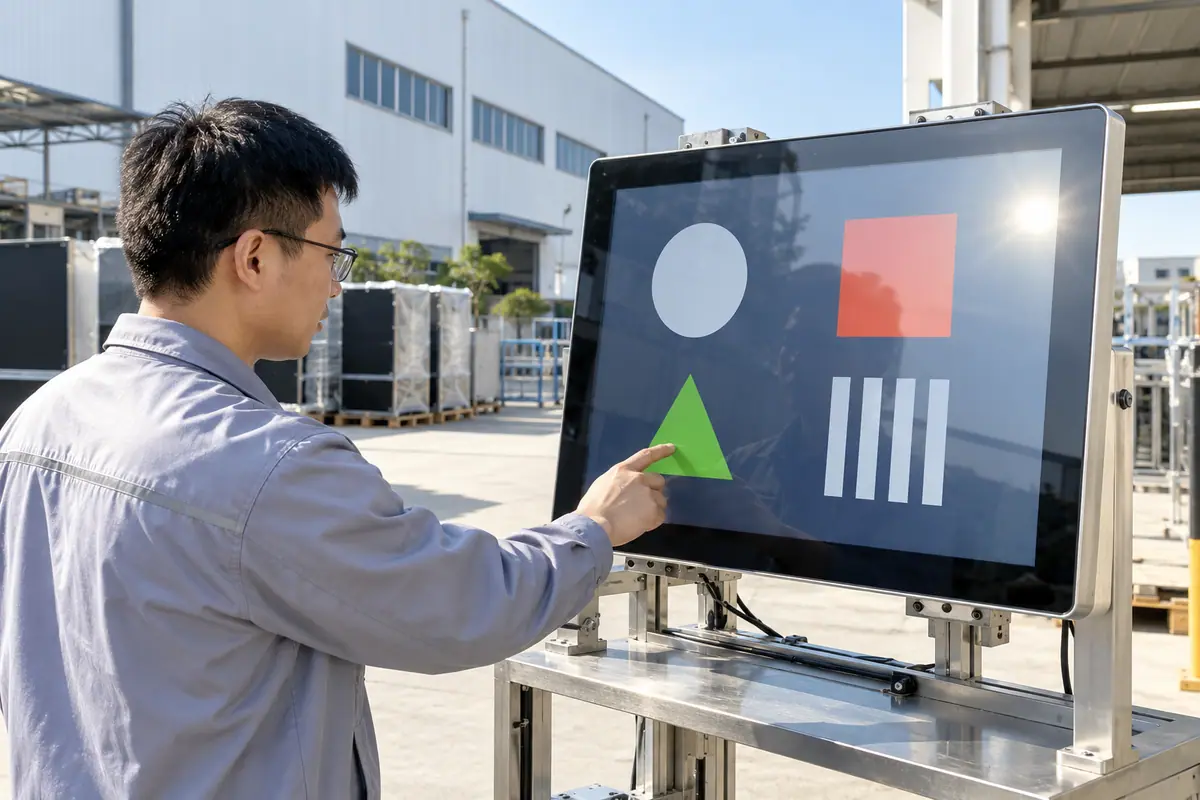
A fully laminated outdoor touchscreen should be selected around the readable task and the installed exposure profile. Suitable joining may reduce reflection at a bonded interface, yet sunlight, front glare, heat, enclosure seals and input conditions remain separate constraints. This guide organizes a practical outdoor sample trial without assuming a brightness value, ingress rating or service life. Define those requirements with the equipment owner and request evidence for the complete proposed assembly.
Contents: 1 · 2 · 3 · 4 · 5 · 6 · 7 · 8 · 9 · 10
1. What outdoor task must remain readable?
Describe the content, viewing distance and user position before choosing a display option. A public instruction screen differs from a short status indicator. Also, canopy shade and light direction can change during use. Set acceptance around recognition of required information rather than around a photograph that merely looks brighter.
A high brightness label may not predict usable contrast. A front-facing demonstration can miss the actual user angle and glare direction.
Buyer checklist for fully laminated outdoor touchscreen
Define the readable task. Identify representative content and viewing conditions with the application owner. Record task success on complete samples, then preserve the settings and geometry that produced the accepted result.
- Required content
- User position
- Shade condition
- Display settings
| Decision point | Requirement to retain | Related check |
|---|---|---|
| Failure boundary | A high brightness label may not predict usable contrast. A front-facing demonstration can miss the actual user angle and glare direction. | Shade condition |
| Approval action | Identify representative content and viewing conditions with the application owner. Record task success on complete samples, then preserve the settings and geometry that produced the accepted result. | Display settings |
A bonding proposal changes the assembled optical and mechanical interface; review its construction context. fully laminated touchscreen construction.
2. Which reflections can bonding actually address?
Distinguish reflection at an internal air interface from glare at the outer cover. Optical coupling addresses the former where the construction is suitable. Meanwhile, coatings, cover geometry and shielding affect other reflections. Compare equivalent complete stacks so the team can identify which design change produced an observed improvement.
A strong outer reflection can remain after joining. Changing the backlight and cover finish at the same time obscures the contribution of bonding.

Which evidence should accompany the sample?
Separate internal reflection and front glare. Establish a baseline with matched settings and viewing geometry. Change one relevant variable where feasible, then evaluate the complete selected design against the actual outdoor task before assigning a benefit.
- Gap interface
- Outer surface
- Matched settings
- Complete-stack result
| Decision point | Requirement to retain | Related check |
|---|---|---|
| Failure boundary | A strong outer reflection can remain after joining. Changing the backlight and cover finish at the same time obscures the contribution of bonding. | Matched settings |
| Approval action | Establish a baseline with matched settings and viewing geometry. Change one relevant variable where feasible, then evaluate the complete selected design against the actual outdoor task before assigning a benefit. | Complete-stack result |
For a machine installation, relate these checks to mounted-console and operator conditions. industrial control touchscreen context.
3. How should sunlight and temperature be evaluated together?
A display can be readable initially and still encounter thermal constraints after exposure. Backlight power, enclosure ventilation and absorbed sunlight affect the mounted assembly. Also, component temperature limits may differ. Have qualified owners define the intended conditions and test method rather than treating a material datasheet as a complete thermal approval.
An optical improvement does not establish thermal margin. A loose room-temperature sample can hide a heat path blocked by the enclosure.
What should the test owner record?
Include the real heat path. Test the powered installed configuration within the approved exposure plan. Track relevant temperatures and functional behavior, then review image, touch and bond condition against the system's defined acceptance criteria.
- Exposure plan
- Backlight power
- Enclosure heat flow
- Functional checks
| Decision point | Requirement to retain | Related check |
|---|---|---|
| Failure boundary | An optical improvement does not establish thermal margin. A loose room-temperature sample can hide a heat path blocked by the enclosure. | Enclosure heat flow |
| Approval action | Test the powered installed configuration within the approved exposure plan. Track relevant temperatures and functional behavior, then review image, touch and bond condition against the system's defined acceptance criteria. | Functional checks |
Healthcare equipment introduces device-specific cleaning and qualification questions; keep those outside generic component claims. medical touchscreen context.
Primary reference: 3M optically clear adhesive application context. Verify its applicable scope against the proposed build.
4. What keeps the perimeter protected?
The optical joint and enclosure seal perform different roles. Review gasket compression, exposed edges, drainage and cable entries as appropriate to the design. Meanwhile, a flush front does not by itself establish an ingress rating. Qualification must apply to the assembled equipment and its actual installation boundary.
Water can reach electronics through a path unrelated to the bonded viewing area. Cosmetic sealing may not provide the required environmental barrier.
Which installed detail needs approval?
Review every entry path. Draw the complete protection boundary and assign its owner. Verify applicable enclosure requirements using the intended assembly, then retain installation and maintenance restrictions with the module specification.
- Perimeter gasket
- Cable entry
- Drainage detail
- Enclosure evidence
| Decision point | Requirement to retain | Related check |
|---|---|---|
| Failure boundary | Water can reach electronics through a path unrelated to the bonded viewing area. Cosmetic sealing may not provide the required environmental barrier. | Drainage detail |
| Approval action | Draw the complete protection boundary and assign its owner. Verify applicable enclosure requirements using the intended assembly, then retain installation and maintenance restrictions with the module specification. | Enclosure evidence |
Compare the application boundary before assuming a single demonstration covers every installation. application solution overview.
5. How should damp and gloved input be tested?
Specify the actual gloves and relevant surface moisture states. A controller tuned for one state may behave differently in another. Also, wiping and droplets can create unintended events. Run required tasks and idle observation on the complete stack rather than assuming that joining independently provides rain or glove compatibility.
A successful dry tap says little about damp idle behavior. A convenient glove substitute may hide a required input failure.

How can engineering close this check?
Test each intended input state. Define repeatable input conditions and failure limits with the application team. Observe taps, drags, release and idle events, then repeat the matrix after tuning or front-stack changes.
- Glove sample
- Moisture state
- Required gestures
- Idle events
| Decision point | Requirement to retain | Related check |
|---|---|---|
| Failure boundary | A successful dry tap says little about damp idle behavior. A convenient glove substitute may hide a required input failure. | Required gestures |
| Approval action | Define repeatable input conditions and failure limits with the application team. Observe taps, drags, release and idle events, then repeat the matrix after tuning or front-stack changes. | Idle events |
Review public supplier information alongside evidence for the actual part being quoted. factory background.
6. Which materials need exposure evidence?
Cover coatings, border printing, adhesive interfaces and seals can respond differently to outdoor exposure and cleaning. Request evidence relevant to the actual materials and conditions. Meanwhile, a generic UV-resistant description does not establish the finished module's lifetime. Avoid converting short trials into unsupported service-life predictions.
A clear initial sample can hide later edge or surface changes. Material substitutions can invalidate evidence attached to the original stack.
What failure would reject this configuration?
Match exposure evidence to materials. Record material references and applicable exposure methods. Inspect optical, surface and input changes against defined limits, then document evidence gaps and prohibit unsupported lifetime claims in the purchase specification.
- Cover coating
- Printed border
- Adhesive reference
- Inspection limits
| Decision point | Requirement to retain | Related check |
|---|---|---|
| Failure boundary | A clear initial sample can hide later edge or surface changes. Material substitutions can invalidate evidence attached to the original stack. | Adhesive reference |
| Approval action | Record material references and applicable exposure methods. Inspect optical, surface and input changes against defined limits, then document evidence gaps and prohibit unsupported lifetime claims in the purchase specification. | Inspection limits |
Send the controlled drawing and unresolved test questions with the sample configuration attached. technical inquiry route.
7. How should power and visibility tradeoffs be compared?
More backlight power can affect heat and the available supply budget. A hood or revised viewing angle may address a different part of the readability problem. Also, automatic brightness behavior introduces another operating state. Compare usable visibility, power and thermal behavior together instead of ranking candidates by a single maximum setting.
A bright short demonstration can conceal an unsustainable operating point. A shading change may improve one user position while obstructing another.
What should quality retain?
Compare useful operating points. Define the operating policy and relevant user positions. Compare complete options under the same task conditions, then select a design that meets visibility requirements within the approved power and thermal constraints.
- Brightness policy
- Supply budget
- Thermal behavior
- User geometry
| Decision point | Requirement to retain | Related check |
|---|---|---|
| Failure boundary | A bright short demonstration can conceal an unsustainable operating point. A shading change may improve one user position while obstructing another. | Thermal behavior |
| Approval action | Define the operating policy and relevant user positions. Compare complete options under the same task conditions, then select a design that meets visibility requirements within the approved power and thermal constraints. | User geometry |
Module quotes need a defined LCD, sensor and controller boundary. touch display module scope.
8. What should outdoor service include?
Decide the replacement boundary, access route and post-repair enclosure checks. A field replacement may disturb a gasket or cable entry even when the optical module is intact. Meanwhile, bond rework may require controlled specialist conditions. Service planning should protect the accepted configuration and environmental boundary after maintenance.
An apparently simple module swap can leave a compromised seal. A substitute controller may require different host settings or input tuning.

Which trial result changes the decision?
Recheck the disturbed interfaces. Demonstrate replacement with maintenance staff using approved parts and procedures. Verify communication, optics, input and disturbed protection interfaces, then retain spare and configuration references for repeat service.
- Access method
- Seal restoration
- Spare revision
- Recovery tasks
| Decision point | Requirement to retain | Related check |
|---|---|---|
| Failure boundary | An apparently simple module swap can leave a compromised seal. A substitute controller may require different host settings or input tuning. | Spare revision |
| Approval action | Demonstrate replacement with maintenance staff using approved parts and procedures. Verify communication, optics, input and disturbed protection interfaces, then retain spare and configuration references for repeat service. | Recovery tasks |
Review the capacitive product context if glass-front or gesture operation enters the specification. capacitive touchscreen options.
For example, a kiosk team might prefer the joined sample for daytime instructions but find false input after a cleaning wipe. Treat readability, damp input and enclosure protection as separate gates. Evaluate controller settings without weakening other required input states, then repeat the actual outdoor task. This hypothetical case illustrates a selection method, not a claimed rating or result for a specific product.
9. What makes outdoor quotes comparable?
Require the same front-stack scope, enclosure responsibility, input profile and test deliverables. Also, customer-supplied displays need incoming condition and loss ownership rules. A supplier can quote optical joining without including complete outdoor equipment qualification. State those exclusions so purchasing does not compare unlike deliverables as if they were equivalent.
A low quotation may omit exposure testing or sealing work. Ambiguous scope can move unresolved risk into the pilot stage.
How can purchasing compare the evidence?
Normalize the quoted boundary. Attach the acceptance and ownership matrix to the RFQ. Ask each supplier to identify exceptions, then reconcile sample evidence and qualification costs before comparing the production offer.
- Module scope
- Enclosure owner
- Test deliverables
- Quote exclusions
| Decision point | Requirement to retain | Related check |
|---|---|---|
| Failure boundary | A low quotation may omit exposure testing or sealing work. Ambiguous scope can move unresolved risk into the pilot stage. | Test deliverables |
| Approval action | Attach the acceptance and ownership matrix to the RFQ. Ask each supplier to identify exceptions, then reconcile sample evidence and qualification costs before comparing the production offer. | Quote exclusions |
Use the pressure-input product context when a suitable blunt stylus or glove is required. resistive touchscreen options.
10. What should the outdoor release preserve?
Freeze the accepted stack, mounting, operating policy and protection interfaces together. Include approved cleaning and service instructions. By contrast, fully laminated outdoor touchscreen does not define a reproducible performance envelope. Changes to the cover, controller, enclosure or brightness strategy need review for their effects on the accepted outdoor tasks.
A factory-equivalent stack can behave differently in a redesigned housing. A customer-side power change can alter the thermal result.
What should the team release next?
Release a defined exposure envelope. Release controlled references and a shared change process. Require relevant supplier notices and OEM reviews, then repeat affected visibility, input, thermal and protection checks before approving the revised configuration.
- Stack reference
- Operating policy
- Protection boundary
- Change triggers
Frequently asked questions about fully laminated outdoor touchscreen
Q1: Does joining guarantee sunlight readability? No. Assess required content on the complete stack under representative light and viewing conditions.
Q2: Is a bonded front automatically waterproof? No. Enclosure protection depends on the complete sealed assembly and applicable evidence.
Q3: Should the brightest sample always win? Compare useful visibility together with power, heat, user geometry and the required operating policy.
Q4: Can a short exposure trial prove service life? No. Keep conclusions within the tested materials, conditions and duration.
Q5: What needs checking after replacement? The approved configuration, input and image behavior, plus any disturbed seal or protection interface.