
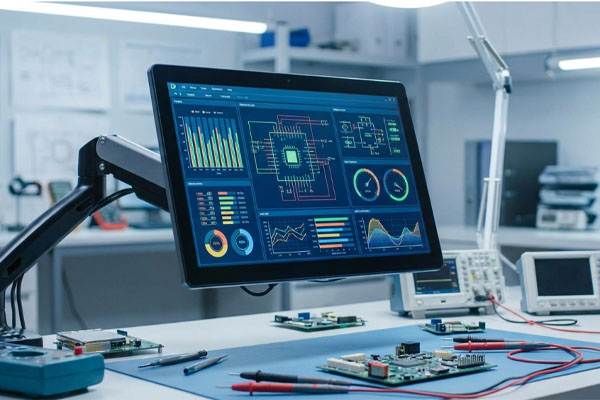
Yes, besides the common 4-wire and 5-wire varieties, you can also find 8-wire and matrix resistive touchscreens. Imagine your production line suddenly stops because a standard interface failed or lost calibration during a critical shift. You need a solution that balances cost, durability, and extreme precision for industrial environments. Exploring high-tier resistive touchscreens allows you to select the precise technology needed for specialized applications.
What are the 8-wire resistive touchscreens?

The 8-wire variety is essentially a more advanced version of the 4-wire design, utilizing additional sensing lines to automatically correct for drift. You will find that these resistive touchscreens provide much higher calibration stability over long periods. This makes them ideal for environments where frequent recalibration is not feasible.
How does the 8-wire circuit function?
This technology adds four sensing wires to the standard four-wire setup to measure the actual voltage at the end of the resistive layers. Look at it this way: by measuring the voltage directly, the controller can compensate for changes in resistance caused by temperature or aging.
- Precision voltage sensing
- Automatic drift correction
- Stable long-term calibration
- Enhanced industrial reliability
| Feature | Specification |
|---|---|
| Wiring Count | 8 Sensing Lines |
| Primary Benefit | Automatic Recalibration |
| Common Use | High-precision Lab Equipment |
Analyzing these technical specs reveals that 8-wire systems solve the specific problem of environmental interference in sensitive settings.
Key Takeaway: You should opt for 8-wire systems when your project demands consistent accuracy without the need for manual maintenance visits to the hardware.
How do matrix resistive touchscreens work?
Matrix resistive touchscreens operate by using a grid of transparent conductors arranged in rows and columns. Instead of measuring a continuous voltage gradient, the system detects a contact point at the intersection of a specific row and column. These resistive touchscreens are often found in applications requiring discrete button inputs rather than fluid cursor movement.
What defines the grid structure?
The grid is formed by etching the conductive coating on the top and bottom layers into distinct strips. Here is the deal: when you press the screen, a row strip contacts a column strip, completing a specific circuit.
- Discrete intersection points
- Digital coordinate detection
- Robust button-style interface
- Lower processing overhead
| Component | Function |
|---|---|
| Top Layer | Horizontal Conductive Strips |
| Bottom Layer | Vertical Conductive Strips |
| Controller | Scans Row/Column Intersections |
This structural design ensures that the input is recognized instantly at a predetermined coordinate without complex analog-to-digital conversion.
Key Takeaway: Matrix designs are perfect for you if your application relies on fixed-position buttons or keys rather than free-form drawing.
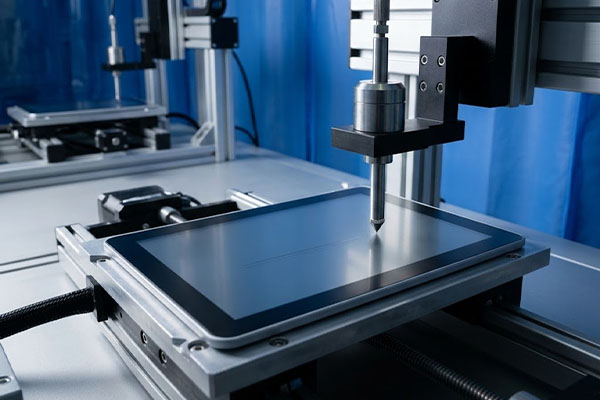
Why choose 8-wire resistive touchscreens?
Choosing 8-wire technology is the right move when you need the reliability of a 5-wire system but with the legacy wiring benefits of a 4-wire base. These resistive touchscreens are specifically engineered to maintain their touch accuracy even as the conductive layers wear down. You won’t have to worry about “touch drift” that plagues cheaper consumer-grade panels.
Is calibration stability important for you?
In high-stakes industrial environments, a screen that loses its calibration can lead to costly operational errors. Think of it this way: the 8-wire system acts like a self-correcting sensor that knows exactly where the voltage levels should be.
- Minimal maintenance downtime
- High resistance to thermal expansion
- Longer interval between calibrations
- Compatible with most 4-wire controllers
| Benefit | Impact on ROI |
|---|---|
| Self-Correction | Reduced service technician calls |
| High Precision | Fewer input errors by staff |
| Durability | Lower total cost of ownership |
The data indicates that 8-wire systems provide the highest level of long-term coordinate accuracy among all resistive types.
Key Takeaway: Investing in 8-wire technology secures your equipment against environmental shifts that typically degrade touch performance over time.
Can matrix resistive touchscreens multi-touch?
While traditional resistive screens are single-touch, matrix resistive touchscreens can technically support limited multi-touch functionality. Because each intersection is a discrete switch, the controller can identify multiple simultaneous presses if they occur on different rows and columns. This makes these resistive touchscreens unique in the resistive family.
How is ghosting handled in these systems?
Ghosting occurs when the controller cannot distinguish between multiple points in a grid. Look at it this way: by using advanced scanning algorithms, the hardware can isolate specific intersections to verify true touches.
- Basic gesture support possible
- Independent button activation
- High EMI (Interference) immunity
- Ruggedized multi-input capability
| Capability | Matrix Type Performance |
|---|---|
| Multi-touch | Basic (2-point) |
| Resolution | Fixed to grid density |
| Reliability | Extremely high for keys |
Understanding the grid logic allows you to design interfaces that can handle “shift-key” style combinations in industrial settings.
Key Takeaway: Use matrix screens if you require a ruggedized surface that can handle simultaneous button presses without the cost of capacitive sensors.

Are 8-wire resistive touchscreens more accurate?
Yes, the 8-wire design offers the most consistent accuracy of any analog resistive technology. By using dedicated sense lines, these resistive touchscreens eliminate the errors caused by resistance changes in the lead wires. You get a raw signal that truly represents the touch location regardless of environmental conditions.
Does voltage drop affect your accuracy?
In large displays, the resistance of the conductive traces can cause the voltage to drop before it reaches the sensing point. Here is the deal: the 8-wire controller monitors the voltage at the screen’s edge and adjusts its calculations in real-time.
- Eliminates lead-wire resistance errors
- Maintains accuracy on large screens
- Compensates for humidity changes
- Superior linearity across the surface
| Error Type | 8-Wire Solution |
|---|---|
| Trace Resistance | Direct sensing at screen edges |
| Thermal Drift | Active voltage monitoring |
| Linearity Bias | Dual-layer sense correction |
The extra wires provide the feedback loop necessary to ensure the cursor stays exactly under your stylus or finger.
Key Takeaway: You should specify 8-wire panels for any screen larger than 15 inches where edge-to-edge precision is non-negotiable.
Where are matrix resistive touchscreens used?
Matrix resistive touchscreens are predominantly found in heavy industrial machinery and public access terminals. They are built to withstand harsh environments where users might be wearing thick gloves or using metallic tools. These resistive touchscreens excel because they don’t require the fine calibration of analog systems to register a button press.
Are these best for industrial keyboards?
Many CNC machines and control panels utilize matrix grids to create “soft-keys” that feel as reliable as physical buttons. Look at it this way: the grid provides a physical-like confirmation of input that analog screens sometimes lack.
- Fuel pump interfaces
- CNC control units
- Security alarm pads
- Automotive dashboard controls
| Application | Why Matrix? |
|---|---|
| Outdoor Kiosks | Handles rain and dirt easily |
| Factory Floor | Operates perfectly with gloves |
| Lab Equipment | Chemical resistant surfaces |
The lack of analog drift means these units can stay in the field for a decade without needing software adjustments.
Key Takeaway: Choose matrix technology for your harshest deployment areas where simple, reliable “on/off” touch detection is the priority.

Do 8-wire resistive touchscreens last longer?
The 8-wire system is highly durable because it can compensate for the degradation of the ITO (Indium Tin Oxide) layer. You will find that these resistive touchscreens remain functional even after the surface has been heavily used and the internal resistance has shifted. This longevity translates to a significantly longer product lifecycle for your specialized equipment.
How does drift impact the lifespan?
In 4-wire screens, once the resistance shifts, the screen becomes unusable because the touch points no longer align with the display. Think of it this way: the 8-wire system “ages” gracefully by constantly recalibrating its internal map to match the current state of the hardware.
- Reduced mechanical wear impact
- High cycle life (millions of touches)
- Stable performance in heat/cold
- Extended replacement cycles
| Lifespan Factor | 8-Wire Advantage |
|---|---|
| Touch Cycles | Up to 35 million |
| Operating Temp | -20°C to +70°C |
| Signal Stability | Maintains 1% linearity longer |
This architectural resilience makes the 8-wire variant the premium choice for mission-critical hardware that cannot afford downtime.
Key Takeaway: For devices with a 5+ year expected service life, the 8-wire variant offers the best protection against signal degradation.
How do matrix resistive touchscreens reduce lag?
Matrix resistive touchscreens reduce lag by simplifying the way the controller “reads” the touch data. Instead of calculating a complex voltage ratio, the controller simply checks if a circuit is open or closed at a specific grid address. This results in incredibly fast response times for resistive touchscreens in high-speed data entry scenarios.
What is the role of digital scanning?
The controller scans the grid at a very high frequency, often hundreds of times per second. Here is the deal: because the output is essentially a digital “yes/no,” the processor spends less time filtering noise and more time reporting the touch.
- Instantaneous button response
- No “settling time” for voltage
- Lower CPU utilization
- Direct coordinate mapping
| Process Step | Matrix Advantage |
|---|---|
| Detection | Digital grid scan |
| Filtering | Minimal noise reduction needed |
| Latency | Sub-10ms response |
The speed of a matrix interface makes it feel much more responsive to the user, especially when navigating menu-driven software.
Key Takeaway: If your user interface requires rapid-fire clicking or high-speed data entry, a matrix grid will provide the snappiest experience.
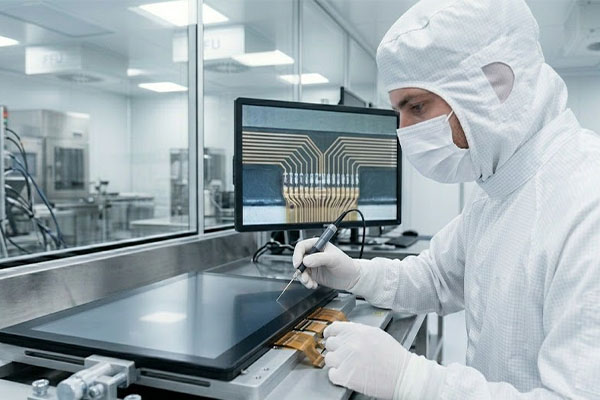
Which resistive touchscreens suit medical use?
For medical diagnostic devices, 8-wire resistive touchscreens are usually the preferred choice due to their extreme precision. They allow healthcare professionals to interact with detailed charts and small interface elements while wearing surgical gloves. Unlike matrix systems, 8-wire resistive touchscreens provide the smooth tracking required for navigating complex medical software.
Is 8-wire or matrix better for labs?
In a laboratory, you might need both: a matrix screen for simple solvent-resistant keypads and 8-wire for precise imaging controls. Look at it this way: the 8-wire system gives you the accuracy of a mouse, while the matrix gives you the durability of a light switch.
- Surgical glove compatibility
- Blood and fluid resistance
- High-resolution tracking
- Stable under fluctuating lab temps
| Medical Setting | Recommended Type |
|---|---|
| Bedside Monitor | 8-Wire (Accuracy) |
| Centrifuge Keypad | Matrix (Durability) |
| Diagnostic Imaging | 8-Wire (Linearity) |
The ability of 8-wire technology to resist interference from other medical electronics makes it a staple in the modern clinic.
Key Takeaway: You should choose 8-wire panels for any medical application where an incorrect touch input could lead to a diagnostic error.
How to source resistive touchscreens?
Sourcing the right resistive touchscreens requires finding a manufacturer that understands the nuances between analog and digital resistive types. You should look for a partner that offers custom stack-ups, including anti-reflective coatings and hardened glass substrates. Ensuring the resistive touchscreens meet your specific environmental rating (IP65 or higher) is critical for long-term project success.
What should you ask a manufacturer?
Before placing an order, you need to verify the controller compatibility and the durability ratings of the ITO layers. Here is the deal: a quality manufacturer will provide detailed data sheets and sample units to test in your actual housing.
- Request linearity test reports
- Ask about tail reinforcement
- Verify operating temperature ranges
- Check for custom size availability
| Sourcing Step | Key Metric |
|---|---|
| Sample Testing | Response time and feel |
| Spec Review | Layer thickness and material |
| Logistics | Lead times and MOQ |
A direct source manufacturer can help you navigate the trade-offs between 5-wire, 8-wire, and matrix technologies based on your budget.
Key Takeaway: Working directly with a source manufacturer allows you to customize the sensor grid or wiring to perfectly match your proprietary housing.

The choice between 8-wire and matrix resistive technology often dictates the success of an industrial or medical product. By understanding that 8-wire systems eliminate drift and matrix grids provide digital-level reliability, you can solve the frequent failures common with standard interfaces. We can help you design and manufacture the ideal touch solution tailored to your specific environmental challenges. Please contact us today to discuss your technical requirements and receive a detailed consultation.
In a world where digital interfaces must survive the harshest physical realities, the right resistive technology ensures that every touch is a command executed with absolute certainty.
FAQ
Can I use 8-wire controllers with a 4-wire screen?No, because the 8-wire controller requires the specific sensing lines found only on an 8-wire panel to function correctly. The hardware logic is designed to monitor those extra voltage points for recalibration.
What is the best type for extreme cold?The 8-wire variety is generally superior for temperature fluctuations. Its ability to sense the actual voltage at the screen edge allows it to compensate for the resistance changes that occur in sub-zero environments.
Can matrix screens be transparent?Yes, they are made using the same transparent ITO materials as standard resistive panels. While you can see the faint grid lines under certain lighting, they are perfectly suitable for mounting over an LCD.
What is the best way to clean these screens?A soft cloth with isopropyl alcohol is usually safe for most high-quality resistive surfaces. Always check the top-layer material spec, as some plastic films may be sensitive to harsh chemicals.
Can I get custom sizes for matrix touchscreens?Yes, manufacturers can etch the grid into almost any custom dimension. This makes matrix technology very flexible for non-standard equipment interfaces or small handheld devices.