

Fully Laminated Touchscreens
for Mission-Critical Applications
Eliminate air-gap failure from the start — with laminated structures built for optical clarity, long-term durability, and consistent batch quality you can count on at scale.
Request a Lamination Solution ReviewWhy Non-Laminated Touchscreens Keep Failing in B2B Projects
Air-gap designs may pass initial inspection — but under real-world conditions, they introduce risks that compound over time. Here is why procurement teams end up with repeat failure reports after the first shipment.
-
Glare & Reflectance DegradationThe air layer between glass and display creates a secondary reflective surface. Under bright ambient lighting — factory floors, vehicles, outdoor kiosks — contrast drops and operators struggle to read the screen clearly.
-
Dust & Moisture InfiltrationThe unsealed gap acts as a pathway for fine particles and humidity. Over months of operation in industrial or outdoor environments, condensation and contamination accumulate behind the glass.
-
Vibration Environment FailureVehicle-mounted displays, industrial machinery, and portable equipment all generate sustained vibration. Without full lamination bonding the stack together, adhesive edges de-bond progressively and touch registration fails.
-
Thermal Cycling & Adhesive DegradationRepeated temperature swings — from cold storage to heated operation — cause the edge adhesive in air-gap designs to expand and contract. Over time, micro-cracks propagate through the bond line, accelerating delamination and display discolouration long before the product's expected service life ends.
Why Samples Pass — and Mass Production Ships Failures
Engineers approve five perfect samples. Then 2,000 units arrive and field failure rates climb. It is a structural and process consistency problem, not bad luck.
Already dealing with field failures or batch inconsistency? Let's review your current structure before the next order.
Get a Free Structure Risk AssessmentFull Lamination Is a Precision Engineering Process — Not Just Adhesive
The term "fully laminated" is often misunderstood. Understanding what it actually involves explains why getting the process right — or wrong — has such a direct impact on product reliability.
Optical Bonding: Eliminating the Air Layer
A carefully selected optical adhesive — OCA film or LOCA resin — is applied between the cover glass and the touch sensor. This fills the air gap entirely, creating a monolithic optical stack that looks sharper and more readable in challenging light conditions.
Bubble Control: Environment and Process Matter
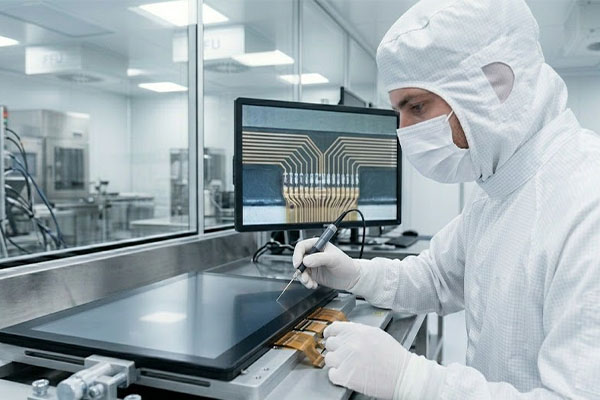
Voids and bubbles in the adhesive layer cause optical defects and delamination under thermal cycling. Proper lamination requires a controlled clean-room environment, specific pressure profiles, and autoclave-level curing to ensure zero retained air — every unit, every batch.
Reliability Testing: Validating Long-Term Performance
A fully laminated touchscreen must survive thermal shock, humidity exposure, vibration, and UV aging without delamination. Structured testing at defined intervals — per batch, not just at qualification — separates designs that hold up in the field from those that fail within the first year.
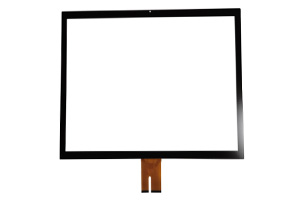
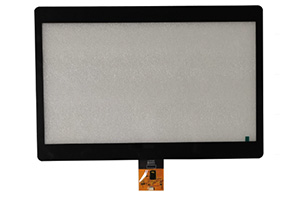
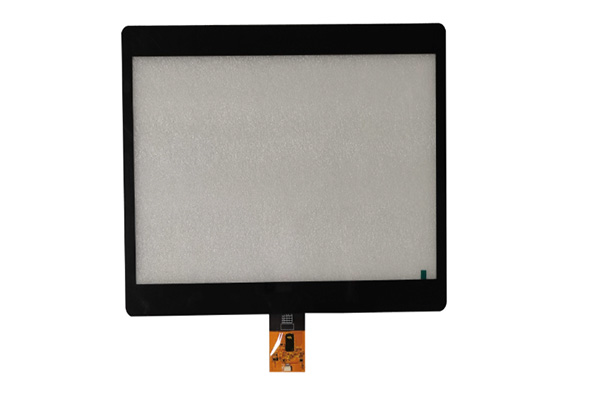
The Cover Glass, Touch Sensor, and Display module are three separate layers. How they are bonded together — the adhesive type, thickness tolerance, curing parameters, and layer alignment — determines whether the final assembly holds together under real operating stress. Choosing a factory that understands these variables is not optional for mission-critical applications.
Want to understand which bonding structure fits your application? Talk to our engineering team.
Discuss Your Lamination RequirementsFully Laminated vs Air Gap: The Real Difference Across the Product Lifecycle
The cost difference looks small at the component level. It looks very different when you account for field return rates, warranty exposure, and customer relationships.
| Performance Dimension | ✦ Fully Laminated — Recommended | Air Gap (Standard) |
|---|---|---|
| Optical Clarity | Near-zero reflectance; high transmittance under any lighting | Air-layer reflection causes visible glare in bright environments |
| Vibration Resistance | Bonded stack moves as one unit — no de-bonding under sustained vibration | Edge adhesive fatigues over time; de-bonding begins at edges |
| Dust & Moisture Protection | Fully sealed — no gap for particles or humidity to enter | Edge gaps allow contamination; fogging appears over time |
| Long-Term Stability | Stable after thermal cycling and UV exposure | Air expansion and adhesive yellowing degrade display quality within 12–24 months |
| Batch Consistency Risk | Controllable with locked process parameters and batch-level testing | Higher variance — manual assembly inconsistency harder to detect pre-shipment |
| Field Return Risk | Significantly lower — failure modes eliminated by structure | Latent failures emerge 6–18 months post-deployment; return rates often reach 5–8% |
Ready to move to a structure that protects your product quality and your customer relationships?
Request a Lamination Solution ReviewThese Industries Cannot Afford Air-Gap Touch Failures
Once a display is deployed in a demanding environment — or is part of a regulated or safety-sensitive product — the engineering case for full lamination becomes mandatory, not optional.
 Industrial
Factory floors expose touchscreens to constant vibration, metallic dust, coolant mist, and wide temperature swings. HMI panels controlling production lines must maintain touch accuracy every shift — field failure causes line stoppage with direct financial consequences.
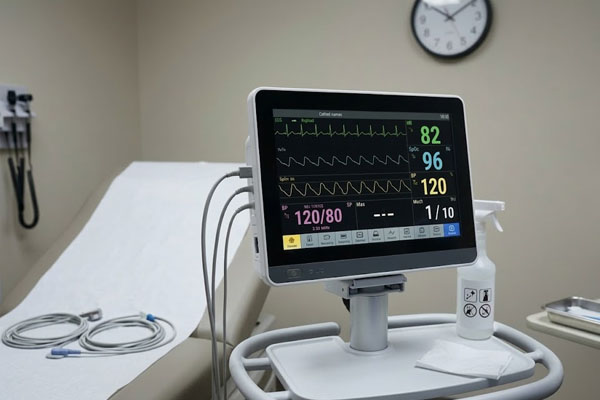 Medical
Touchscreens in patient monitoring and diagnostic equipment must be cleanable with disinfectants and operate reliably in sterile environments. Moisture and chemical infiltration through unsealed gaps is a direct safety risk and a regulatory compliance failure.
 Vehicle
Automotive and fleet navigation displays operate across −20°C to +70°C with persistent road vibration and direct sunlight exposure. All three of these conditions expose the weaknesses of air-gap structures within the first year of operation.
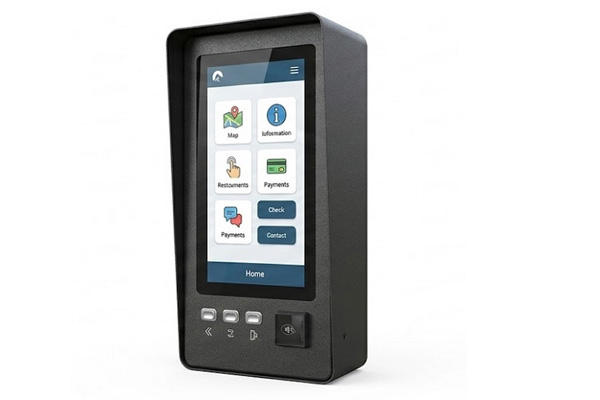 Outdoor
Self-service kiosks and outdoor terminals face direct solar glare, rain, dust storms, and temperature extremes simultaneously. Fully laminated AR designs achieve readability at 1000+ nits — air-gap units are often unreadable in direct sunlight before any other failure occurs.
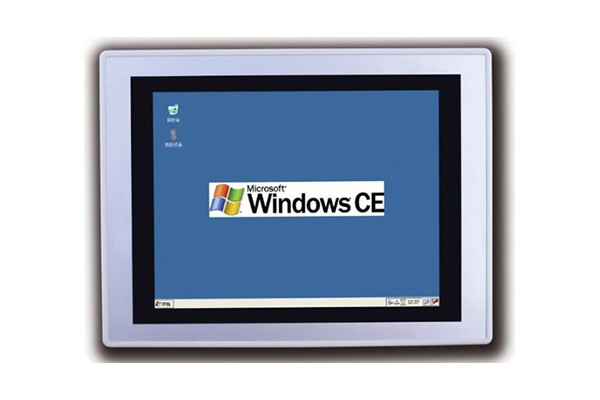 Marine
Navigation and command displays on vessels and defense platforms must operate in salt air, high humidity, and shock environments indefinitely. Any display that is not fully sealed will corrode, fog, or lose touch calibration within one operational season.
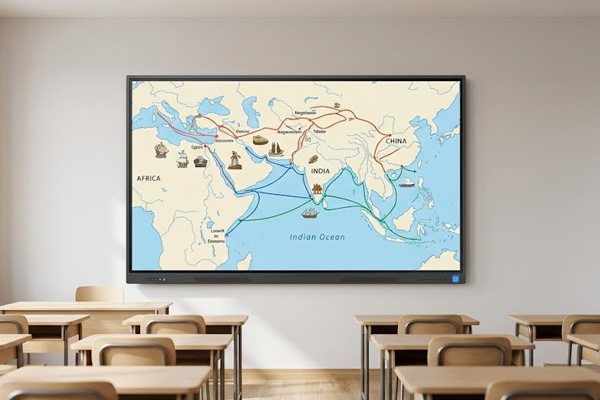 Education / Pro AV
Large-format interactive displays in classrooms and conference rooms face heavy daily touch usage, cleaning chemical exposure, and high ambient light. Air-gap panels develop visible dark patches at edges from cleaning fluid ingress, and touch accuracy degrades from repeated moisture exposure.
Is your application on this list? Let's confirm the right lamination structure for your deployment environment.
Tell Us About Your ApplicationWhat Our Process Can Handle — And Where the Hard Limits Are
Overselling capability and under-delivering at mass production is the most common breakdown in the touchscreen supply chain. We document our boundaries clearly so engineering teams can make decisions on real data.
Our lamination process is qualified across the ranges below. These figures reflect validated production parameters — not engineering targets or theoretical limits. Anything outside these ranges requires a new qualification process, which we will tell you upfront rather than commit and discover later.
Size Range & Custom Shapes
Standard rectangular and custom-profile cover glass in the 1.5"–32" range. Irregular shapes are handled by custom-cut cover glass and dedicated bonding fixtures — tooling cost is quoted upfront.
Display Compatibility
Compatible with IPS, TN, OLED, and e-paper display modules. Touch interface support covers PCAP, resistive, and in-cell configurations. Interface matching is verified at DFM stage before first sample.
Batch Consistency Controls
Adhesive lot traceability, clean-room class 1000 environment, autoclave curing with logged pressure and temperature profiles, and 100% optical QC inspection per unit are standard — not optional upgrades.
Long-Term Supply Stability
BOM-locked production means the adhesive system, cover glass specification, and process parameters used at qualification are the same ones used in batch 50. Engineering change control is a formal gated process, not a silent substitution.
Want to know if your spec falls within our validated range? Send it to us and we will give you a direct answer.
Send Us Your Spec for a Capability ReviewSix Dimensions We Can Customize — All Documented in the Production Spec
Custom configurations are only valuable if they are reliably reproduced at mass production. Every customization we offer is supported by a formal specification that locks in the parameter at qualification and tracks it through every subsequent batch.
Glass Thickness & Surface Treatment
Cover glass thickness from 0.55mm to 4.0mm, in tempered or chemically hardened variants. Surface options include full AR coating, AG finish, AF coating, and combinations — specified by environment and cleaning protocol requirements.
0.55mm – 4.0mm · AR / AG / AF optionsAdhesive Type & Curing Method
OCA film or LOCA resin selected based on panel flatness, rework requirements, and operating temperature range. Autoclave curing parameters — pressure, temperature, and dwell time — are fixed in the production recipe at qualification.
OCA / LOCA · Autoclave-cured per recipeOptical Performance Targets
Transmittance, reflectance, and haze targets are set at DFM review and measured per batch via integrating sphere. For high-brightness outdoor applications, we specify against an ambient illuminance model rather than a generic lab standard.
Transmittance ≥ 92% · Haze < 1% standardInterface Matching & Connector Layout
Touch interface FPC routing, connector position, and tail-length specifications are aligned with your PCB layout at the DFM stage — not adjusted post-sampling. This prevents the common problem of connector clash discovered during first assembly.
FPC routing locked at DFM approvalMechanical Tolerance & Edge Profile
Overall assembly thickness tolerance is held to ±0.15mm. Edge chamfer angle, radius, and bezel-to-display alignment are specified in the dimensional drawing and verified at first article and then sampled per production batch.
±0.15mm assembly tolerance · Sampled per batchFirmware Configuration
Touch controller sensitivity, palm rejection, stylus support, and communication protocol parameters (I2C, USB HID, UART) are configured to your system specification and validated against your host platform before production sign-off.
I2C / USB HID / UART · Host-validatedHave a customization requirement not listed here? Share your spec and we will tell you what is possible.
Start a Customization DiscussionThe Gap Between Sample Approval and Mass Production Reality
Sample approval is a snapshot. Mass production is a process. The buyers who have field failure problems are almost always buying the first — and assuming it guarantees the second. Here is what actually determines whether batch consistency holds over time.
Root Causes of Batch-to-Batch Failure
-
Unlocked Adhesive SpecificationWhen the adhesive lot grade is not locked at qualification, suppliers substitute with available inventory. Different lots introduce viscosity and cure-rate variation that changes bubble formation and layer uniformity at scale.
-
Variable Curing ParametersAutoclave pressure and temperature profiles that are manually set by operators — rather than recipe-controlled — drift across shifts and between operators. Even small deviations reduce adhesive cross-link density and long-term delamination resistance.
-
Inadequate Clean-Room DisciplineParticulate contamination at the bonding interface is invisible at shipping inspection. Under thermal cycling, trapped particles create stress concentrations that initiate delamination — discovered by your customer six months after deployment.
-
No Outgoing Batch DataWithout per-batch test records, there is no early warning when process drift begins. By the time failures appear in the field, multiple batches may already be in transit or installed.
How We Prevent It
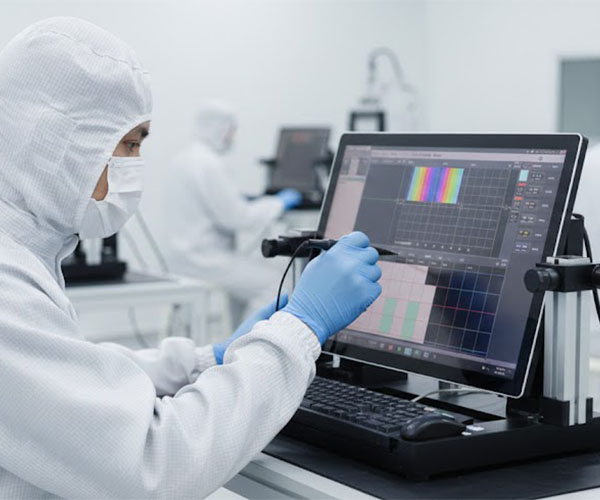

Want to audit our process before placing a production order? We welcome factory visits from qualified customers.
Request a Consistency Audit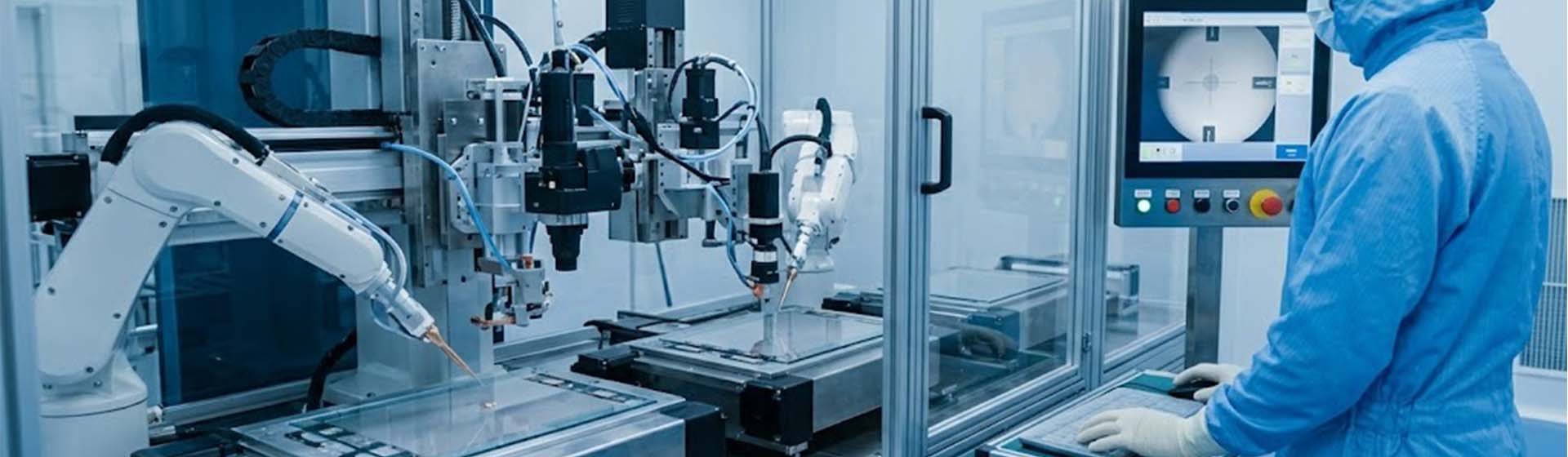
Every Unit Built to the Same Validated Standard
Six interlocked process steps — each with defined inputs, inspection checkpoints, and documented outputs. No shortcuts between your approval sample and the thousandth unit.
Incoming Inspection
Every incoming glass panel, adhesive lot, and display module is inspected against the approved material specification before entering the production line. Non-conforming lots are quarantined — not reworked into production.
Clean-Room Lamination
Bonding is performed in a Class 1000 clean-room environment. OCA or LOCA application follows the recipe-controlled procedure for that product. All operators are trained and certified on the specific product fixture before production starts.
Autoclave Curing
All bonded assemblies go through autoclave curing with locked pressure and temperature profiles per product recipe. Run logs are automatically recorded. Assemblies that do not complete a full valid curing cycle are reworked, not shipped.
Optical QC
Every unit is inspected under controlled lighting for bubble count, delamination area, adhesive uniformity, and cosmetic defects per the approved acceptance criteria. Results are logged against the batch record.
Aging Test
Production samples from each batch undergo accelerated aging — thermal cycling, high-temperature humidity, and mechanical vibration — per IEC or customer-specified test protocol. Batch is released only after aging pass is confirmed.
Outgoing Sign-Off
Before shipment, every delivery receives a package of outgoing documents: batch QC summary, aging test result, adhesive lot certificate, and dimensional report. These ship with the product, not on request after a problem is raised.
Want to see the full process documentation before your first order? We provide it proactively.
Request Process DocumentationWhat Happens When Batch Consistency Meets Real-World Deployment
These are real engineering problems, solved with real lamination decisions. The results speak for themselves when you look at the field return numbers after the first production run.
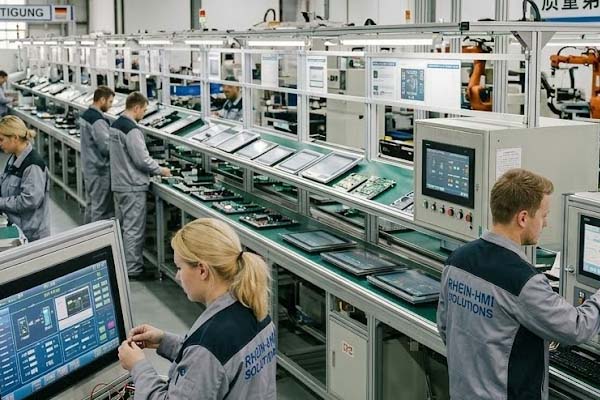 Industrial · Germany
Industrial HMI Manufacturer — Germany
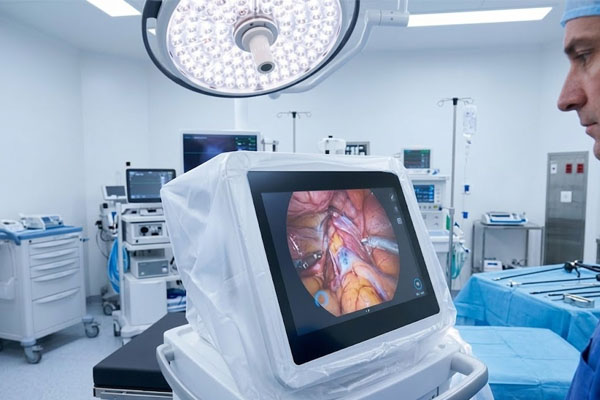 Medical · Taiwan
Medical Device OEM — Taiwan
 Outdoor Kiosk · Singapore
Outdoor Kiosk Integrator — Singapore
Want to discuss a similar challenge? Tell us about your project and we'll share what has worked in comparable applications.
Discuss Your ProjectNot a Sales Pitch — Six Reasons Engineers Keep Coming Back
These are the observations customers share after their first production run. We include them because they reflect what we actually prioritize — not marketing claims written before a single unit shipped.
You Are Talking Directly to the Factory
No trading company, no intermediary, no one re-labelling another factory's product. When you ask a process question, the answer comes from the engineer who designed the lamination fixture — not a salesperson checking a brochure. When something changes in production, we tell you before it ships, not after.
Engineering Communication That Doesn't Waste Your Time
We are trained to ask the questions behind the questions — what is the operating environment, what is the cleaning protocol, what happens if the unit fails in the field? The answers shape the design recommendation, not just the quote.
We Name the Risks Before You Sign Off
If your operating environment is at the edge of what our validated process handles, we say so. If your timeline is too tight to properly qualify a new adhesive system, we tell you that rather than commit and apologize later. This earns us long-term supply relationships instead of one-off orders.
Long-Term Supply Experience Across Demanding Sectors
We have shipped laminated touch solutions into industrial, medical, vehicle, and outdoor deployments across North America, Europe, and Southeast Asia. The operational knowledge — how products fail in the field, what procurement teams actually need — is embedded in how we approach every new project.
Flexible Minimum Order, Serious Production Capacity
We accommodate first-production orders as low as 200 units for qualified customers — because scaling to volume requires building confidence first. Our production capacity scales to 50,000 units per month without impacting lead time for existing customers, so your volume growth doesn't need a new supplier conversation.
After-Sales Support That Closes the Loop
If a failure report comes in from the field, we do not wait for you to build a case. We request the failed units, investigate against our batch records, and provide a written root cause and corrective action report within 10 business days as standard. Our batch traceability system makes this process fast and conclusive.
Ready to work with a factory that treats your project risks as its own?
Start a Conversation With Our Engineering TeamA Clear Process That Gets You From Requirement to Production Without Surprises
Every step is designed to eliminate the gaps where most supplier relationships break down — specification drift, undisclosed substitutions, and late-stage surprises before mass production.
We collect your application spec, environment conditions, and display requirements in a structured brief. No loose emails — a documented baseline.
1–2 Business DaysEngineering proposes a lamination structure, adhesive system, and glass specification — with written rationale for each recommendation.
3–5 Business DaysProduction samples are built using the confirmed spec — same materials, same process parameters as mass production.
10–15 Business DaysYou test samples against your criteria. We provide our internal test data. Deviations are documented and resolved before sign-off.
Customer-ControlledProduction proceeds using the approved BOM and locked process recipe. Batch records maintained. Outgoing QC data provided with each delivery.
Lead Time Agreed at PO- Structured application brief
- Environment risk checklist
- Baseline spec document
- Structure recommendation memo
- Adhesive rationale summary
- Tooling & NRE cost estimate
- Samples built to production spec
- Our internal test data
- Revision round if needed
- Deviation log & resolution record
- Golden sample archived
- Signed approval documentation
- Batch records per delivery
- Outgoing QC report
- Traceable lot documentation
Ready to start Step 1? Send us your application brief — we respond within 24 hours.
Start the Requirement ReviewQuestions Procurement Engineers Ask Before Their First Order
Your question isn't listed? Send it directly — an engineer will answer it, not a sales template.
Submit a Technical QuestionDon't Risk Your Next Product Launch on an Unstable Touch Structure
Field failures compound. One bad batch creates returns, RMA cost, and customer confidence damage that takes multiple clean shipments to recover from. The structural decision you make now determines whether your next deployment is the start of a long-term supply relationship — or the beginning of a problem you'll be explaining to your customers.
Talk to a Factory That Understands Lamination Risks
Tell Us About Your Project — We Will Respond With an Engineer, Not a Template
The more context you provide, the more useful our first response will be. Even a rough sketch of your application is enough to start a meaningful conversation.
What Happens After You Submit
Your inquiry is reviewed by an application engineer within 1 business day. The response addresses your specific application context — not a generic catalogue response.
-
Within 1 business day Engineering team reviews your submission and prepares a specific, relevant response — not an auto-reply with a product PDF.
-
Application-specific questions We may ask 2–3 follow-up questions about your operating environment to give you a more accurate structure recommendation.
-
Initial structure recommendation Based on your brief, we propose a lamination structure and ballpark cost range — giving you what you need to decide whether to proceed to full quotation.
-
No commitment required The engineering review is provided at no cost and with no obligation. We do not use the inquiry process to pressure a sales decision.
Fields marked * are required. The more detail you provide, the faster we can give you a useful response.